

TOP > Student Voice (Denis Otroshchenko)

Student Voice

Denis Otroshchenko
Home country: Uzbekistan
*Mr. Otroshchenko graduated from the LL.M. in Global Legal Practice and received a Certificate in Business Law in March 2026.
*Name shown according to the student's preference for Japanese phonetics.
How did you find out about the LLM program, and what attracted you to pursue it?
I became interested in studying masters in Japan long ago, followed up by my short-term visit to Tokyo and Hiroshima in 2023 awarded by the Ministry of Foreign Affairs of Japan under the "MIRAI" programme. I found the program while specifically looking for master programs closely related to my field (international law) and liked the diversity of courses offered and their content.
The location also strongly appealed to me, as Tokyo's position at the heart of Japan offers diverse opportunities for personal and professional development, especially given my initial interest in extending my stay after completing my master's. Since I am not an alumnus of a Japanese studies program and my specialization focuses on international contexts, selecting a smaller city or pursuing programs requiring proficient Japanese would not have been ideal choices.
A significant advantage was the program duration. As a MEXT Scholarship recipient, I also had research completion requirements and was enrolled in Japanese language courses, which together with perfectly complemented the LL.M.'s one-year degree requirement - made this the most time-efficient choice.
Please tell us about your most memorable class, along with the reason why.
"Drafting International Agreements" taught by Lecturers Kenji Hosokawa and Sam Inohara in the fall semester was a blast. Organized in an up-to-date real-time review format, and interesting assignments rather than outdated textbooks from Meiji era, the course helped me to improve my drafting skills and see how practitioners from a more competitive environment look at drafting, explain key nuances, and use modern legal tech. I also enjoyed "American Law and Society," taught by Professor David G. Litt. The course provided first-hand insights into the United States from an American perspective. I appreciated that it extended beyond purely legal topics to explore broader aspects of American society and culture.
What do you enjoy about life at Keio?
Initially, I did not expect that course registration would be fully flexible and that there would be no mandatory subjects. During my bachelor's studies, it was extremely difficult to balance academic work with other activities and personal development because the schedule was fixed. However, the flexibility of the LL.M. program allows for a high degree of efficiency in planning and maintaining a healthy study-life balance. This is particularly beneficial for students engaged in additional activities, such as taking Japanese language courses or working alongside their studies.

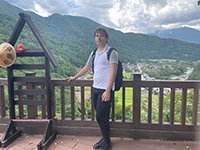
In terms of leisure activities, there is plenty of time to explore Japan during winter or summer break. Personally, I was able to explore Kanazawa, Shirakawa-go, Hakone, and many other iconic places of Japan.
What are your plans after you finish your studies at Keio? What do you think you will take with you from this experience?
After finishing my master's studies, I was accepted into a PhD program, and I plan to continue improving my Japanese language skills while seeking opportunities to combine my doctoral studies with professional activities in the field of law.
Any advice for prospective LLM students? How would you recommend the Keio LLM program to the students?
The program offers excellent flexibility to choose courses that align with your interests, along with several certificate options that allow you to further highlight your strengths and specialization. Before registering for courses, I would recommend carefully reviewing the degree and certificate (if you are planning to apply for one) requirements and determining which areas of law you need credits in to meet your academic goals and fulfill the program's requirements. Moreover, I would also highlight interrelation between the program and country choice for masters. If the choice is between Japan and other countries, and especially if it your first-time studying abroad, Japan might be a better choice compared to some of more popular study destinations. Personally, I haven't encountered any difficulties in finding housing, accessing healthcare, and overall adaptation, while the Keio International Center (scholarship coordinators in my case) are also extremely helpful and responsive. This directly enhanced the efficiency of my studies.
(This interview is from March 2026.)
